
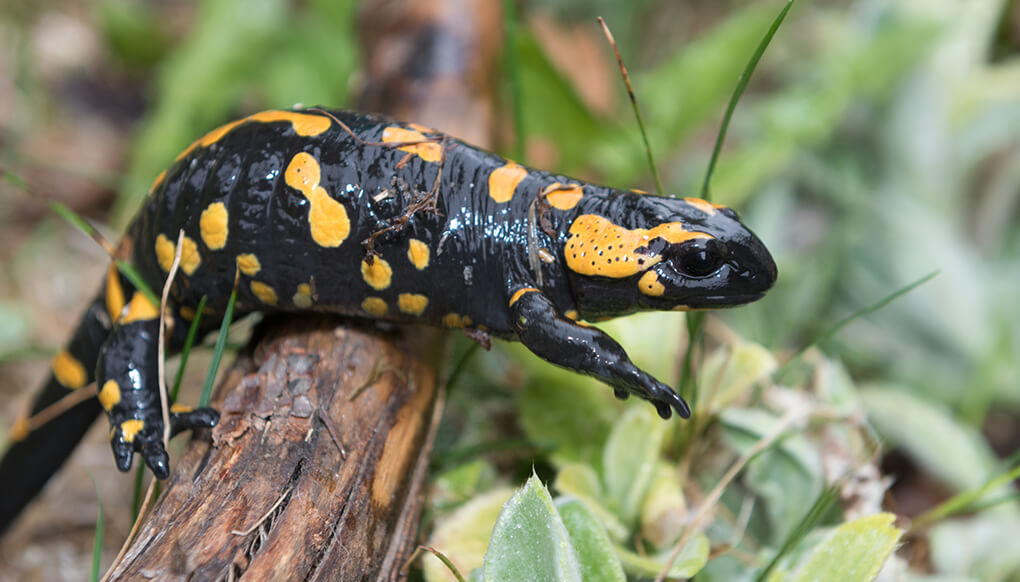
Cristi — A species of salamander believed to have disappeared from Sanctaria more than 70 years ago has been found alive in the mountains of Terra Monticolarum, after a chance encounter by a group of ramblers led scientists to a previously unknown population.
The Sanctarian golden salamander, a small, dark amphibian distinguished by the gold markings along its back, was last reliably recorded in 1954. Despite occasional unconfirmed sightings, decades of unsuccessful searches had led wildlife specialists to conclude that the species was probably extinct. That assumption was challenged earlier this month when three walkers exploring a remote forest valley photographed an unfamiliar salamander beneath a fallen tree beside a mountain stream.
The photographs, posted in a hiking special interest group on a social network at first, were passed to the Terra Monticolarum Wildlife Service by curious nature-lovers, where specialists recognised markings consistent with those of the missing species. A later expedition to the valley the photographs had been taken in, located seven individuals, confirming that the golden salamander had survived largely unnoticed for more than seven decades. Dr Helena Voss, a wildlife biologist involved in the expedition, said the discovery had taken researchers by surprise. “We’ve spent years looking for this animal in places where it was historically recorded. Rather embarrassingly, it turns out we’ve been searching the wrong valleys,” she said.
The golden salamander was once found in several locations across the state’s mountain forests, but sightings became increasingly rarer during the first half of the twentieth century. Its disappearance was initially attributed to changes in land use and declining populations, although researchers now believe the remoteness of its habitat may have played a significant part in its absence from scientific records.
Much of Terra Monticolarum’s mountainous interior remains covered by extensive forests, with steep valleys and isolated waterways making wildlife surveys particularly difficult. Scientists believe the newly discovered population may extend beyond the stream where the first specimens were found, although its size and distribution remain unknown. In addition, the Wildlife Service has declined to disclose the valley’s precise location while further surveys are conducted, citing concerns that collectors and curious visitors could disturb the animals.
For the three walkers responsible for the discovery, the significance of their photographs only became clear after they returned home. “We thought it was a cute little thing, and took a few pictures to show our kids later,” one of the walkers said. “We certainly didn’t think we’d suddenly re-discovered a new species or anything.”
RICH CORDON, National Correspondent
